
Use of Stem Cell Growth and Differentiation Factors (Scdsf) in Central Vertigo
Abstract
The clinical use of SCDSF factors in neuro-degenerative pathologies offers a potential therapeutic opportunity. Our observational study aims to evaluate its efficacy in patients affected by Central Vertigo1.
A case series divided into two subgroups, all affected by non-migrainous central vertigo, was selectively subjected, in epigenetic terms versus the genome, to the administration of SCDSF with a regenerative action or to the administration of a reprogramming and then regenerative action. The cohort was divided into two groups due to the emergence of a resistance to the action of neuro-regenerative SCDSF when administered individually according to consolidated therapy schemes. To recover efficacy, it became necessary to first administer reprogramming SCDSF and only subsequently the neuro-regenerative SCDSF.
The observation that a therapeutic barrier was overcome during the study—a barrier to the action of neuro-regenerative SCDSF, only when preceded by the administration of reprogramming SCDSF versus the genome—highlighted a deeper mechanism. A targeted action aimed at recovering the functionality of the epigenetic code was employed to counteract environmental epi-genotoxicity.
Article Information
- Received
- Accepted
- Published
Academic Editor: Anubha Bajaj, Consultant Histopathologist, A.B. Diagnostics, Delhi, India
Checked for plagiarism: Yes
Review by: Single-blind
Copyright © 2026 Gianpaolo Pisano, et al.
 This is an open-access article distributed under the terms of the Creative Commons Attribution License, which permits unrestricted use, distribution, and reproduction in any medium, provided the original author and source are credited.
Corresponding author: Giorgia Grappeggia, UPSM International University of Milan —
Competing Interests
The authors have declared that no competing interests exist.
Funding
No specific funding statement was provided by the authors.
Data Availability
No data-availability statement was provided by the authors.
Citation:
Introduction
The underlying pathology of Nervous System degeneration can be considered, until now, orphan of therapy. Currently, the dogmatic concept of irreversibility of degeneration mechanisms within the Nervous System prevails. This work represents an attempt to expand the limits of therapeutic actions in the field of central vertigo.
We were encouraged by positive data obtained in a clinical trial on a case series of neurosensorial hearing loss treated with stem cell reprogramming factors (SCDSF)2. Added to this are experimental data on the regeneration of Nervous System tissue in the CA1 area of the mouse hippocampus3. Other examples of neuro-regeneration in mammals come from advanced research confirming the existence of active adult neurogenesis throughout life in specific cerebral areas: the dentate gyrus of the hippocampus, the sub-ventricular zone of the lateral ventricle, and the rostral zone directed towards the olfactory bulb4. Other experiences contribute to demonstrating the breaking of a dogma, such as the ability of post-natal cardiomyocytes to generate iPS cells with an acquired capacity for cardio-myogenic re-differentiation5.
The cited processes refer to the resident stem cells in adult tissues, which are involved in damage repair, including neurodegeneration, within a context of neuroplasticity6. Given these premises, it was decided to initiate an observational study on central vertigo.
The first experimental approach to the degenerative suffering of the central nervous system with SCDSF factors occurred in the context of the limbic system7. These studies, besides demonstrating their efficacy, allowed a leap beyond the reductionistic conception, both in terms of research and therapy. In fact, a selective administration of single SCDSFs, essentially small molecular weight proteins and microRNAs, did not lead to appreciable results. Conversely, the administration of the entire regenerative package, consisting of all the identified embryological factors, allows for more significant results8. This experience, which opens the way to therapy for all degenerative pathologies of the nervous system and sensors, with the exception of ALS, surely represents a turning point as the advent of epigenetics modifies certain dogmatic attitudes in biology and, particularly, in medicine9,10.
Sensory afferents reach the limbic system, so this apparatus contributes to the mechanisms of learning and consolidation of information to be memorized (verbal or semantic/declarative type) and spatial memory11. The path towards an informational, non-pharmacological therapy against the genome of a perennial cell in an epigenetic key was opened with the aid of embryological factors (SCDSF), marking a historical turning point. Later, research would reveal a readiness on the part of the epigenetic code for biophysical modulation12. The epistemological process of an informational medicine, not exclusively molecular but also biophysical, has been outlined, as described by the philosopher of Science E. Laszlo and the biologist R. Schelldrake13,14.
Central vertigo corresponds to degenerative processes that may involve brainstem structures15. Cases of central vertigo in its statistically most common form, i.e., vertigo in the migrainous16 patient, were not recruited for this study. Nor were patients with vertigo during Multiple Sclerosis, a pathology for which a dedicated study is underway by us. Symptomatology varies based on the nervous pathways involved in the management of static and dynamic balance. A particular role is recognized for the limbic system, the site of anterograde memory and spatial orientation17, often implicated at the onset of central vertigo.
The transition from physiological forms of loss of balance function mastery, such as presbyastasis18, to frankly pathological forms is often subtle19. Important signals include falls, as in cases affected by drop attacks, or ataxic gaits. It is not uncommon for the patient to complain of hearing loss, in the presence of tinnitus, a sensation of an empty head (dullness) with varying degrees of difficulty in mnemonic function, and sometimes cognitive disturbances20. Reported headaches are of a pressure type. Before therapy with SCDSF, the only notable therapies were nutraceutical and biophysical.
Let's briefly analyze the therapeutic proposals involving biophysical information. It is known in the audiological and otorhinolaryngological fields that sound offered through binaural21 acoustic prosthetics or, more specifically, proposed in sonic therapies with personalized playlists, can contribute to a therapeutic action via biophysical mechanisms22,23. It is believed that such therapies induce improvement, as observed in patients treated for long periods, through neuroplasticity mechanisms24. Immediate effects, observed after only a few seconds of sonic stimulation, suggest a modulation of electrical synapses: in auditory evoked potentials, an improvement in latencies, wave peaks, and trace clarity is noted, a sign of greater oto-neurological coherence25. Furthermore, we believe that neuroplasticity26, the long-term target, represents the essence of any feasible therapy in patients affected by neurodegeneration, in order to induce an implementation of the general performance status of all superior functions connected to the CNS.
The fact that sound proposed in digitalization, with its symbolic informational load, can increase cognitive and attention performance is not surprising to those who understand the premises of the "extended mind"27,28, concept, and/or the brain as an open system equipped with dissipative dynamics according to G. Vitiello29. Before proceeding, it must be said that different approaches to quantum physics applied to medicine result in interpretive nuances, which, however, do not change the substance of our reasoning. In such an emerging conception, the idea of the neuron as the fundamental morpho-functional unit, which was still considered by E. Schrodinger30 himself, is dismantled. The dynamics of coherence domains of the convoluted systems take over in a new physiology capable of explaining paradoxes, including the reduced energy expenditure compared to the number of computations performed by the brain31,32.
R. Penrose, Nobel laureate in Physics in 2020, supported first by Hameroff and then by Diòsi, considers the neurofibrillary system a priority in quantum computation mechanisms. This consists of about 900 grams of fundamentally protein material, in the context of which microtubules are identified as the fundamental element of physiology, at the interface between mind and brain33. These three authors describe a dynamic system where phonons, photons, and the gravitational field can maintain their correlations34. The fact that a fundamentally protein system plays a role that is not exclusively structural but also functional, in our opinion, supports the idea that this neurofibrillary system is posited as a priority target for SCDSF action35.
To stay on the topic of correlation between phenomena relevant to molecular biology and those attributable to quantum biophysics, it must be said that the two dimensions interact starting from the period of embryogenesis throughout the entire period of adult life, in health or in disease. SCDSF quickly find their affinity partners, far beyond what is expected from Brownian diffusion, suggesting that electromagnetic background effects facilitate rapid selections: this underlies the mechanisms of bioresonance36,37. In this perspective, reference is made to morphogenetic fields, capable of guiding specific cellular attractions, consistent with the thermodynamics of dissipative systems. From these considerations derives the concept of the morphogenetic code38,39,40, whose influence on cellular dynamics is supported by physical actions41.
It is believed that in epigenetics, the sectors of degeneration and oncological pathology are strictly connected. Based on what has been observed, it can be hypothesized that tumor attractors resonate close to embryonic attractors42, as tumor cells are to be considered stem cells43,44. In Quantum Field Theory (QFT), it is believed that the same symmetry-breaking mechanisms45 that regulate phenomena in particle physics and condensed matter also operate in biology. SCDSF would be able to regulate the fundamental steps of the cellular cycle, inducing electrochemical modulations and consequently the electrodynamic behaviors between the bipolar networks in the present macromolecules. These facts occur physiologically in the embryonic environment where water is in the 4th state, but also pathologically in the tumor context46.
The interactions between Energy and Matter extend throughout the entire adult age. Prof. E. Del Giudice, starting from the positions of QED47, believes that the entire "orchestration" of the electromagnetic background field determines the succession of known biochemical and biomolecular reactions48. More recently, Prof. G. Vitiello, recalling the experiment of Prof. J.L. Montagnier49, affirms that a physical ordering force field precedes the molecular structuring of the genome itself.
Given these very encouraging premises, in any case, we had to note the lack, until now, of specific therapeutic measures capable of regenerating a damaged cellular compartment, namely the neuron. Therapy with stem cell growth and differentiation factors (SCDSF), capable of reprogramming and regenerating cells of the nervous system, has opened up new therapeutic perspectives50. Neurological pathologies of a degenerative nature, with the exception of ALS, have provided the opportunity for verification. In central vertigo, leukoaraiosis51, easily detectable on MRI and correlated with central vestibular involvement evaluated through vestibology, was chosen as a marker of severity.
The classification of SCDSF and their therapeutic use have been carried out since the year 200052. In brief synthesis, these factors are involved in many cellular pathways, including signal transduction, cell cycle regulation, chaperoning, and protein synthesis and degradation53. Five phases of extraction are distinguished during the embryogenesis of the Zebra Fish; this distinction proves to be extremely useful for the clinical use of the SCDSF themselves54. The first three phases have a regenerative action, while the last two phases have genomic reprogramming actions, thus being able to induce transformations in cancerous cells, as demonstrated in vitro and in vivo with clinical works55, with apoptogenic actions56, especially of phase 5, defined as oxidative, if repair mechanisms are no longer possible. The factors extracted from Zebra fish caviar are over 90% identical to human ones, which is not surprising when evaluating the interactions between phylogeny and ontogeny.
The molecular protagonists of an epigenetic code, in synergy with the morphogenetic field, allow for the regulation of a large part of molecular traffic. Recently, an independent Japanese team, Un. of Kyoto, confirmed all the contents of the epigenetic research supported by Dr.Biava and his collaborators, which underlies the use of SCDSF, pushing the limit of scientific considerations further57.
Clinical Case 1
The first case dates back to the pre-COVID pandemic period. This was a 74-year-old man affected by type 2 diabetes, hypertension, and dyslipidemia. Despite excellent clinical control, he reported a gradual worsening of motor skills, balance, and cognitive functions. The patient started regenerative SCDSF therapy, taken three times a day, with clinical check-ups every 15 days, bringing the required tests each time. At the time of enrollment, the otovestibular examination performed with a rotatory method and nystagmus recording showed a central pattern. The MRI showed a picture of leukoaraiosis of 2nd–3rd degree according to Fazekas58. Already at 3 months, the patient visibly improved from a vestibular point of view, but above all reported being able to read the newspaper again without losing the thread of the narrative after a few lines, as happened before starting the therapy.
Clinical Case 2
The second case, which due to its complexity cannot be fully detailed here, will be briefly outlined. This is a 54-year-old female smoker, not previously affected by any pathology. At the onset of a profound headache, she was accompanied by her spouse to the Emergency Room of the San Carlo Hospital in Milan. Admitted at 11 am, she was promptly examined by staff and quickly underwent a CT scan, which revealed the rupture of an aneurysm of the right middle cerebral artery. At 4 pm, she was taken to the operating room. Following a laborious intervention, she underwent resuscitation, where she was operated on again to decompress a cerebral edema intractable with medical therapy. After being discharged, she was hospitalized again to reconstruct the cranial vault with a synthetic prosthesis. Due to neurological complications, she underwent another decompressive craniotomy, which, however, did not manage to avoid a paralysis of the left hemisome. After neuromotor rehabilitation, the patient remained with stable paralysis of the left hemisome and bilateral tremor in the upper limbs. At home, she began SCDSF therapy, taken three times a day sublingually, with progressive improvement up to the complete disappearance of the tremor in about four months. Survival is due to the neurosurgical intervention, and neurological recovery is attributed to SCDSF therapy, currently being published as a case report. Neuroradiologists documented cerebral regeneration in the area of the right middle cerebral artery, still defined by the obsolete term "neuromalacia". The patient is currently asymptomatic, despite the suspension of therapy, thanks to the epigenetic nature of the SCDSF, which induce stable molecular changes over time.
Objective
Our study aims to demonstrate, from a purely clinical point of view, the "efficacy or non-efficacy" in a neuro-regeneration action using therapy with stem cell growth and differentiation factors (SCDSF). The study is observational, so apart from the evaluation of the exhaustive documentation that each patient always carried with them, the first visit and follow-up were set up focusing on finding a possible implementation of autonomous motor skills and the recovery of sensory, memory, and cognitive faculties.
Materials And Methods
The study was carried out on a case series afferent to the Experimental Vestibology Center of the UNISED University of Milan. The in-person team consisted of a Neurologist, Otorhinolaryngologists, a Medical Researcher in Clinical Epigenetics, and two physicists tasked with evaluating the methodological rigor of all phases of the observational study. All patients had already been examined in various settings, already characterized by a diagnosis of central vertigo and therefore equipped with imaging tests, especially magnetic resonance imaging but also CT scans of the Central Nervous System, neurological and otorhinolaryngological visits, instrumental otovestibular exams (electronystagmography and stabilometry) and caloric tests, capable of evoking the vestibulo-ocular reflex according to an objective method, which earned Robert Barany the Nobel Prize in Medicine in 191459,60. All these methods are perfectly capable of establishing the centrality of a vestibular disorder. The richness of diagnostic means highlights, in greater contrast, the total absence of therapy.
For this reason, despite the completeness of the documentation already in their possession, all patients were subjected, at entry and exit, to a neurological visit and an otorhinolaryngological visit with evaluation of clinical vestibular function through the Side Bed Examination61, hot and cold thermal tests according to the Veits method62, using Frenzel glasses63 for the collection of spontaneous and provoked nystagmus. The cross-referencing of the collected data allowed monitoring the response to SCDSF therapy. Those who decided to adhere to the observational study, once informed about the lack of side effects and pharmacological interactions of the SCDSF, received a check-up at three months, chosen to reduce the risk of confounding variables related to age and answer the fundamental question: is the therapy effective or not effective?
It is reiterated that the first male patient, affected by a severe form of central vertigo with gait disturbances, disorientation, and memory issues, and who tested positive for 2nd–3rd degree leukoaraiosis on MRI, showed improvement after less than three months of treatment, confirming what was already observed in previous work on neurosensorial hearing loss.
The protocol for the administration of epigenetic factors was as follows:
| Protocol | Type of SCDSF | Embryonic Stage (Zebrafish) | Pharmaceutical Form | Dosage | Total Daily |
|---|---|---|---|---|---|
| 1 – Regeneration | SCDSF Regeneration | 1st – 2nd – 3rd stage | Sublingual Tablets | 1 tablet at 8 am, 2 pm, and 8 pm (3 tablets/day) | 3 g/day |
| 2 – Reprogramming | SCDSF Reprogramming | 4th – 5th stage | Drops (30 drops = 1 ml) or Spray (7 sprays = 1 ml) | 1 ml at 8 am, 2 pm, and 8 pm (3 ml/day) | 3 g/day |
| 2 – Alternating | SCDSF Regeneration | 1st – 2nd – 3rd stage | Sublingual Tablets | 1 tablet at 8 am, 2 pm, and 8 pm (3 tablets/day), alternating with the reprogramming protocol | 3 g/day |
An important clarification was given to the patients: the recommendation that the factors should be taken sublingually, so as not to expose the SCDSF to the digestive action of the gastric environment.
The protocol variation was initiated in January 2024. This became necessary due to the emergence of cases resistant to single regenerative therapy, which appeared in the second half of 2023. Four patients (no. 15 F, no. 16 F, no. 17 F, no. 18 F), while fully meeting the indication characteristics for the therapy with the aforementioned factors, no longer responded to the administration of stem cell growth and differentiation factors (SCDSF). In addition, similar resistance began to be noticed in patients affected by neurosensorial hearing loss, treated by the Authors of this work in normal clinical practice. As is easy to assume, neurosensorial hearing loss offers the opportunity to suggest what happens in the CNS in degenerative terms, in the physiological terms of primary aging like presbycusis, or pathological terms like secondary aging.
It was therefore considered that environmental pressures had emerged capable of altering the genomic reaction to the epigenetic action supported by the SCDSF. Such alterations in the functional capacity of the epigenetic code must, logically, be identified among those ubiquitous factors capable of acting universally and within a precise timeframe, corresponding to the duration of the observational study.
At this point, it was decided to open a parenthesis in the management of an ongoing case series, subjecting two additional cases, which were not introduced into the cohort of patients of the observational work, to a therapeutic variation.
Pilot Cases with Therapeutic Variation
| Case | InitialDiagnosis | Conventional Therapy | Protocol with SCDSF | Treatment Duration | Results |
|---|---|---|---|---|---|
| 1 | Vertigo from ochlea-vestibular nerve distress + severe neurosensorial hearing loss (50 dB) + total paralysis of left VII cranial nerve (Ramsay Hunt syndrome, Herpes Zoster oticusetiology left) | Corticosteroids, antivirals, anti-vertigo drugs → only VII cranial nerve paralysis resolved, vertigo and hearing loss persisted | Reprogramming (4th–5th stage): 30 drops + 1 tablet × 3/day for 8 weeks, sublingual | Vertigo improved already at 15 days; complete auditory recovery after ~6 weeks | Resolution of vertigo and severe neurosensorial hearing loss; MRI negative for retrocochlear Oto-neurological lesions |
| 2176 | Bilateral neurosensorial hearing loss (more accentuated on the left) in an octogenarian hypertensive patient; MRI negative | No specific effective pharmacological therapy | Alternating Reprogramming (4th–5th stage) and Regeneration (1st–3rd stage): cycles of 15 days each, in succession | 3 months, with 2 check-ups per month | Almost complete recovery of the auditory gap between the left and right ear, with improvement also on the right |
To remain in an oto-neurological context, it is recalled that the Epstein Barr virus, in a spectrum of increasing severity in its ability to insult the human genome, is responsible for chronic tonsillitis pictures, sustained by a “blastization” of infected B lymphocytes64,65, and nasopharyngeal carcinoma. Most evidently, and as proof that the viral genome is capable of interacting with the human one, patients with numerous EBV reactivations show syncytia and/or alterations of the nucleus of epithelial cells on nasal cytology66,67, which are evident alterations of a pathological interaction at the nuclear level. Multiple sclerosis also correlates with the Epstein Barr virus68,69,70.
As further examples of interaction with pathological outcomes, some oncogenic RNA viruses, defined as retroviruses, can be enumerated, which, being equipped with a reverse transcriptase, are capable of inserting exogenous genomic information into the human genome starting from RNA71. The previous examples are given to demonstrate how a viral action can induce a modification of the human genome. We owe to researchers J.M. Bishop and H. Varmus, Nobel laureates in 1989 for Physiology and Medicine, the awareness of a possible viral etiology of tumors as a result of a dynamic opposition between oncogenes and oncorepressors72.
Based on these encouraging observations on the two pilot cases, the subsequent case series was treated, from then until July 2024, exclusively with the protocol that first involves the reprogramming of altered cells and then the regeneration of the same. In summary, two periods, with two diversified protocols in succession, were outlined in the global management of the cases of our observational work. Two cases received both protocols (case no. 17 of the 1st group became case no. 4 of the 2nd group); this patient was placed in both case series. This is an 87-year-old woman who had not responded to the first protocol, so she was subjected to the second protocol for an additional 3 months of intake. At follow-up, she showed significant improvement upon neurological scrutiny and clinical vestibular function assessment. A second case, a 73-year-old female (case no. 18 of the 1st group became case no. 16 of the second group), had not responded to the 1st protocol in vestibular and neurological terms but responded very well to the 2nd protocol. It must be said that the marked central improvement—this was a case with cerebellar functional implications—was not accompanied by an equally evident improvement in left pantonal neurosensorial hearing loss. We recall that the proposed method does not implant but activates existing stem cells in the context; this aspect is clearly a limiting factor.
A third patient, a 76-year-old woman, non-responsive to the first protocol, belonging to the first group, did not agree to undergo the 2nd protocol (case 16 of the 1st protocol). A fourth patient (case no. 15), a 69-year-old woman who had not responded to the 1st protocol, despite having accepted the 2nd protocol, did not attend the scheduled follow-up (included as case 15 in the second group).
The evaluation of these four cases, included as non-responsive in the first case series, led us to believe that an environmental genotoxic factor, probably viral, was capable of hindering the regenerative action. Until then, the regenerative action, with positive clinical outcomes, was obtained with the exclusive administration of the regenerative factors of the first three stages of embryological development. In summary, two periods, with two diversified protocols in succession, were outlined in the global management of the cases of our observational work. The results of the two protocols will be presented in the Results section (Figures 1–3), followed by the descriptive tables.
Results
As shown in Figure 1, the overall trend of the clinical efficacy of SCDSF factors in patients with central vertigo shows a clear increase after the introduction of the second protocol.
Figure 1.Trend of clinical efficacy of SCDSF factors in patients with central vertigo, divided into the two observation periods (September 2022 – December 2023 and January 2024 – July 2024).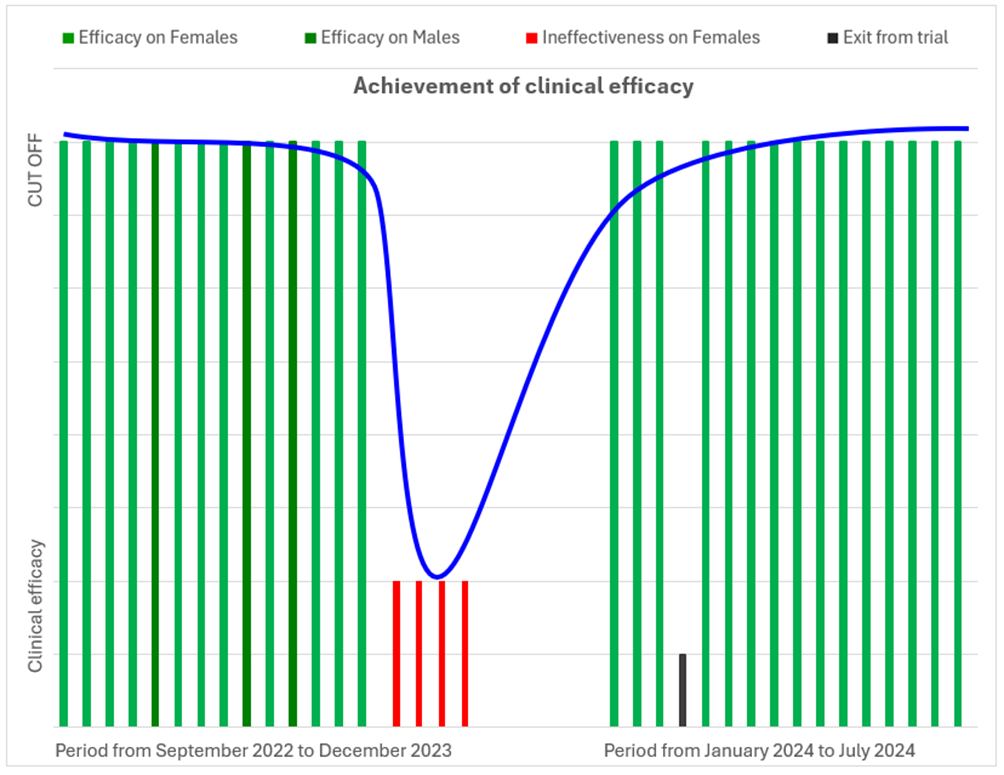
Download figure
The distribution of results relating to the first protocol is shown in Figure 2. It shows that most patients responded positively, although with some non-responsive cases.
Figure 2.Results of the 1st group treated with the first protocol (September 2022 – December 2023).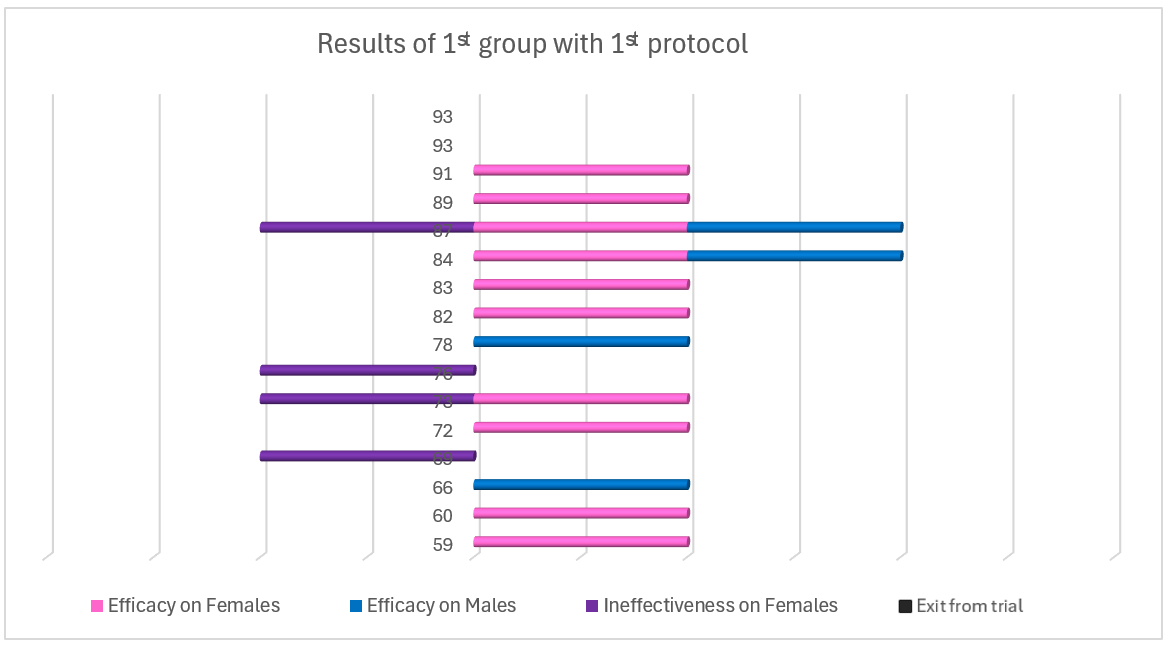
Download figure
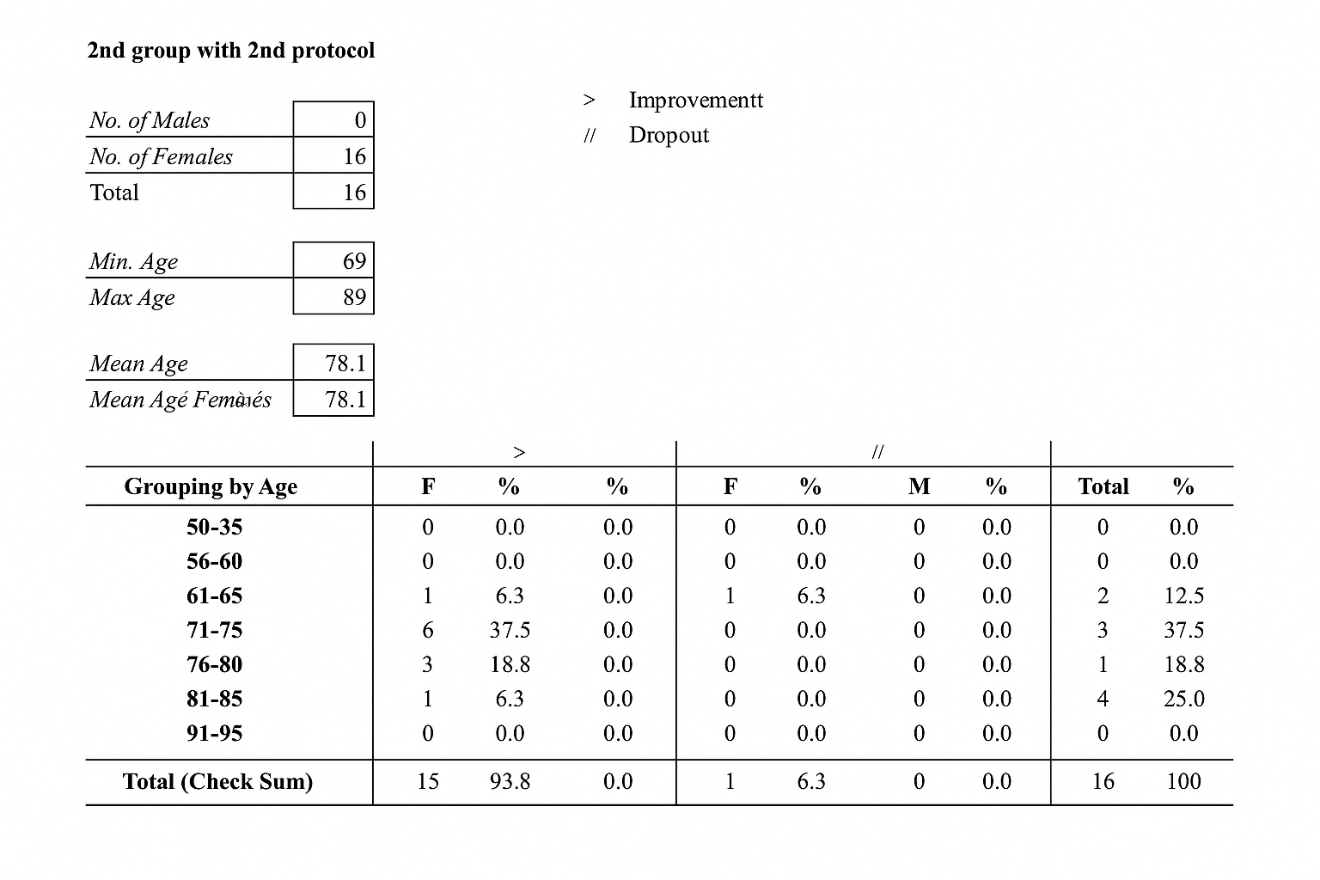
For the second protocol, Figure 3 highlights that almost all patients responded favorably to the combined treatment.
Figure 3.Results of the 2nd group treated with the second protocol (January 2024 – July 2024).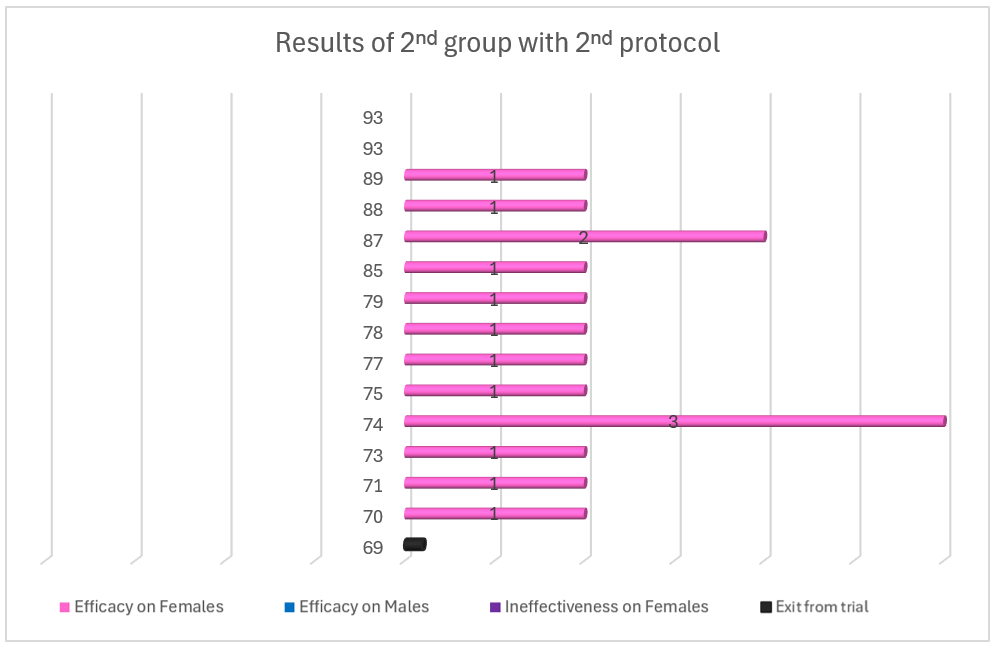
Download figure
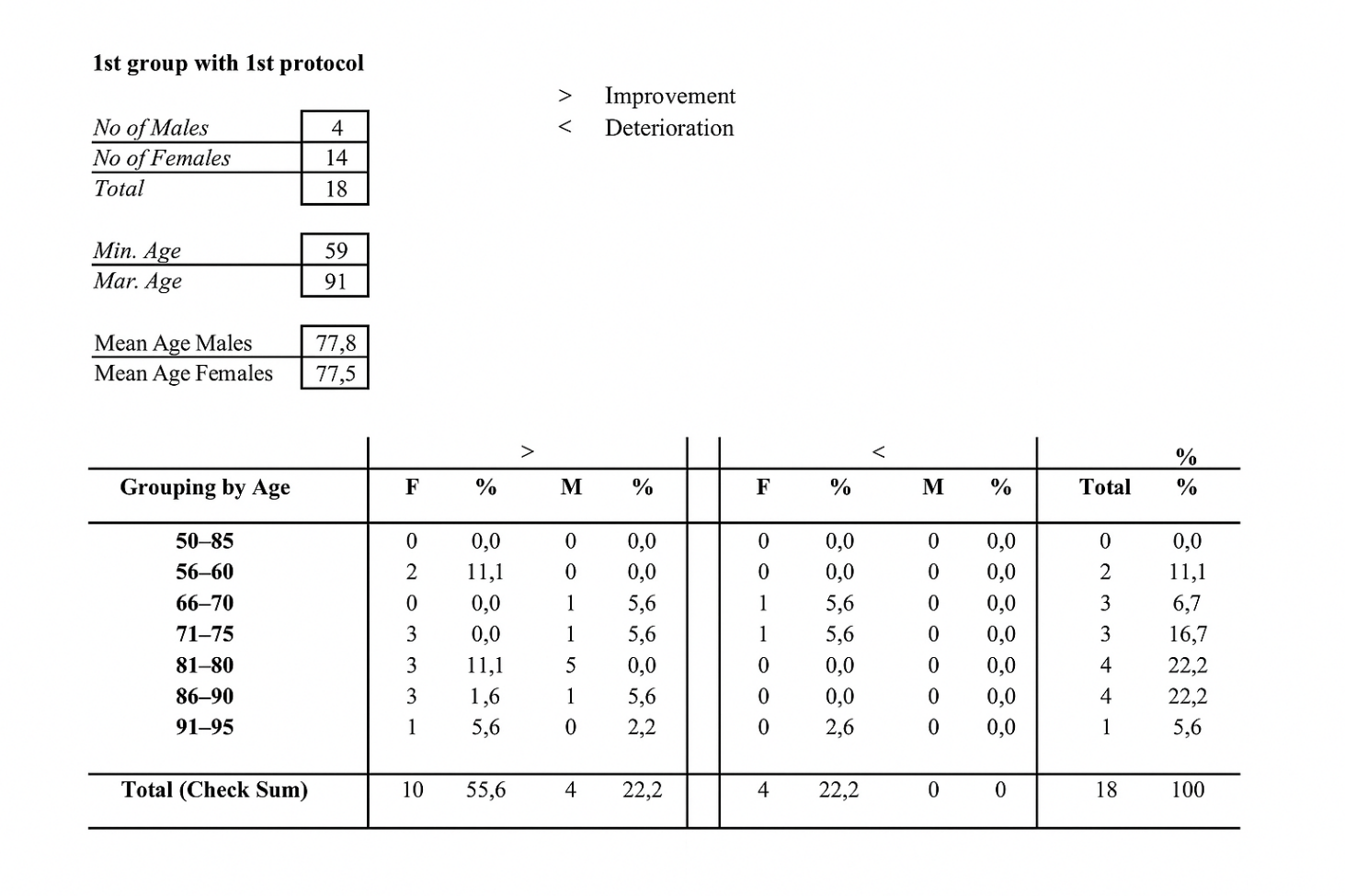
To integrate the graphical observations, Table 1 and the subsequent tables report in detail the characteristics of the case series studied, divided by protocols and age groups. These numerical data allow for a more precise quantification of the patient distribution and the demographic profiles of the treated groups.
Case Series Tables
| 1st Protocol | |||||
| N° of Males | 4 | N° of Females | 14 | Total | 18 |
| Min. Age | 59 | Max Age | 91 | ||
| Mean Age | 77.77 | Mean Age Males | 78.75 | Mean Age Females | 77.5 |
| 2nd Protocol | |||||
| N° of Males | 0 | N° of Females | 16 | Total | 16 |
| Min. Age | 69 | Max Age | 89 | ||
| Mean Age | 78.125 | Mean Age Males | - | Mean Age Females | 78.125 |
| Overall | |||||
| N° of Males | 4 | N° of Females | 30 | Total | 34 |
| Min. Age | 59 | Max Age | 91 | ||
| Mean Age | 77.94 | Mean Age Males | 78.75 | Mean Age Females | 77.83 |
| 1st Protocol : Grouping by Age | F | % | M | % | Total | % |
|---|---|---|---|---|---|---|
| 50-60 | 2 | 11.1 | 0 | 0.0 | 2 | 11.1 |
| 61-70 | 1 | 5.6 | 1 | 5.6 | 2 | 11.1 |
| 71-80 | 4 | 22.2 | 1 | 5.6 | 5 | 27.8 |
| 81-90 | 6 | 33.3 | 2 | 11.1 | 8 | 44.4 |
| 91-100 | 1 | 5.6 | 0 | 0.0 | 1 | 5.6 |
| Total (Check sum) | 14 | 77.8 | 4 | 22.2 | 18 | 100.0 |
| 2nd Protocol : Grouping by Age | F | % | M | % | Total | % |
|---|---|---|---|---|---|---|
| 50-60 | 0 | 0.0 | 0 | 0.0 | 0 | 0.0 |
| 61-70 | 2 | 12.5 | 0 | 0.0 | 2 | 12.5 |
| 71-80 | 9 | 56.3 | 0 | 0.0 | 9 | 56.3 |
| 81-90 | 5 | 31.3 | 0 | 0.0 | 5 | 31.3 |
| 91-100 | 0 | 0.0 | 0 | 0.0 | 0 | 0.0 |
| Total (Check sum) | 16 | 100.0 | 0 | 0.0 | 16 | 100.0 |
| Overall :Grouping by Age | F | % | M | % | Total | % |
|---|---|---|---|---|---|---|
| 50-60 | 2 | 5.9 | 0 | 0.0 | 2 | 5.9 |
| 61-70 | 3 | 8.8 | 1 | 2.9 | 4 | 11.8 |
| 71-80 | 13 | 38.2 | 1 | 2.9 | 14 | 41.2 |
| 81-90 | 11 | 32.4 | 2 | 5.9 | 13 | 38.2 |
| 91-100 | 1 | 2.9 | 0 | 0.0 | 1 | 2.9 |
| Total (Check sum) | 30 | 88.2 | 4 | 11.8 | 34 | 100.0 |
All patients who reached the clinical follow-up, which involved a neurological and clinical vestibular function re-evaluation similar to the entry assessment, reported and showed evident improvements concerning the mastery of gait, confidence, and mastery in movement, with the resolution of that pathological caution that characterizes central, typically non-rotatory, vertigo420.
The vestibular signs that most revealed progress are:
· Romberg's test73: negativization of retropulsion.
· Unterberger's test74: correct execution, not feasible without the aid of correct central vestibular function.
· Caloric tests according to Veits: four patients in the first group showed the same nystagmic reaction pattern at the control, namely hyper-reactivity to hot and cold tests with very evident qualitative alterations of the provoked nystagmus, such as arrhythmias, grouping of beats, slow phase slips, or verticality elements. In the other patients of the first group and in all patients of the second group, the nystagmic reaction at follow-up of the vestibular test showed qualitative improvements and a quantitative recomposition of the number of beats towards a normal range.
On the symptom side, highly welcomed improvements reported were mental clarity, improved reading ability, and anterograde memory, which the patient autonomously perceives by tackling crosswords or simply reading newspapers.
Regarding the correspondence between responsiveness to therapy with stem cell differentiation and growth factors (SCDSF) and the lesions described on CNS MRI, we deem it appropriate to report some data7.
· Patient no. 15 of the first group, a 69-year-old woman, non-responsive to the 1st protocol, affected by meningioma, 2nd-degree leukoaraiosis, systemic arthritis with elevated ESR, and steatosis with moderately elevated transaminases. Despite having accepted the 2nd protocol, she was excluded from the trial as patient no. 15 because she did not attend the scheduled follow-up.
· Patient no. 16, a 76-year-old woman from the first group, did not respond to the 1st protocol, despite having prolonged it on her own initiative up to 5 months. On MRI, she presented a picture of 3rd-degree leukoaraiosis according to Fazekas with important notes of cerebral atrophy. She did not enter the second group having refused to undergo the 2nd protocol.
· Patient no. 17, an 87-year-old woman, non-responsive to the 1st protocol, accepted the second protocol, which proved effective towards all therapeutic targets433. Therefore, she also belongs to the second group as case no. 4. She presented a picture of 2nd-degree leukoaraiosis.
· Patient no. 18, a 73-year-old female, affected by central cerebellar-type vertigo, did not respond to the first protocol, while she responded well to the 2nd protocol (included as case no. 16 in the second group) regarding central vestibular symptomatology. She did not improve regarding left pantonal neurosensorial hearing loss (2nd degree according to Fazekas). We believe that this situation depends on the availability of contextual stem cells; we recall that the method with stem cell growth and differentiation factors (SCDSF) does not involve transplantation of the same.
· In reference to all other patients, in both case series, who responded to the two protocols, only four cases showed 1st-degree lesions, while all others had 2nd-degree lesions according to Fazekas.
Adverse Events
Some patients reported gastralgias, but were able to continue therapy by taking a gastric protector consisting of a Proton Pump Inhibitor. One case was rejected as allergic to fish proteins; this type of allergy represents a formal contraindication to the administration of SCDSF. Patient no. 13 of the 2nd group, a 70-year-old female, despite having reduced the protocol to two administrations per day on her own initiative due to the onset of gastric side effects, showed a clear improvement at clinical follow-up. We have already noted the fact of efficacy preservation in case of dosage reduction; after all, it is an informational medicine. However, it must be said that in the case of treating neoplastic patients with genomic reprogramming factors, it is necessary to increase the dosage. Such a clarification comes directly from Prof. P. M. Biava.
Final Considerations
The second protocol, characterized by a first reprogramming step preceding the second regenerative step, fully restored the previous efficacy of therapy with stem cell growth and differentiation factors in terms of intensity of symptomatic gain/objective and chronological response to therapy.
Analysis of Results
The work clearly shows, with an on/off mechanism, the efficacy of epigenetic therapy with stem cell growth and differentiation factors in central vertigo pathology. Of the 18 patients in the 1st group, 14 responded positively to therapy. Of the 16 patients in the 2nd group, 15 responded positively. One patient could not be evaluated (case no. 15) as he did not attend the scheduled follow-up.
We must admit that we could not have imagined how the progressively emerging loss of efficacy in four patients of the first group would stimulate us to find a new therapeutic strategy, reasoning on the acquired knowledge about the mechanisms of the epigenetic code75. In fact, knowing precisely the epigenetic regulation mechanisms induced by SCDSF factors, which have been commercially available for some years, it was natural to first consider a reprogramming therapy and then a genome regenerating therapy. This transition, which in our opinion represents the most important contribution of our work, requires a synthetic explanation.
At the current state of research, it is considered acquired that three codes exist:
· Genetic code76: inherited from parents at birth, it behaves like a computer hard drive that is predisposed to give rise to all the substances that constitute our body, but only if provided with the specific instruction program that regulates its functioning.
· Epigenetic code: offers the possibility of genome reprogramming through the two known mechanisms of transcriptional or post-transcriptional activation. Both mechanisms, as stated, are capable of activating a block release against the antagonistic influence on cellular regeneration activities.
· Morphological code: is based on physical actions, predominantly electromagnetic, already discussed previously. It cannot be excluded that a physical “barrage” hindered the neuro-regenerative actions of the SCDSF from the first three phases.
The fact that the activation of the aforementioned mechanisms became necessary raises a focus of attention on what could have interfered in a limited timeframe and on a large scale. Due to the action of this presumably viral unknown factor, a situation of greater fragility was created in the patients. In fact, patients affected by degenerative pathologies of the Central Nervous System, as a consequence of an interaction on a molecular biology plane, are deprived of a possibility offered by cellular regeneration factors, unless preceded by the reprogramming factors. The same therapeutic dynamics are required in neoplastic patients, who benefit if treated with the same factors aimed at reprogramming the genome77. Conversely, it is not prudent to administer cellular regeneration factors to the same patients.
Conclusions
The present work highlighted that patients who do not respond immediately to neuro-regeneration treatments with growth and differentiation factors (SCDSF) extracted in the first three phases of zebrafish embryological development can only find a regenerative response if this is preceded by a more selective cellular reprogramming therapy carried out with the same factors (SCDSF) developed for this purpose, extracted from the later phases of zebrafish embryological development; in particular, the fourth and fifth of the five described phases. We interpret such a lack of initial reactive response to the regenerative factors as due to a cytotoxic, genotoxic, but above all, "epigenotoxic" effect78. Numerous proactors in the environment are capable of creating a block in the physiological modus operandi of the epigenetic code; however, the perspective of our concluding considerations does not change: "namely that in current circumstances, it is useful to reprogram before regenerating".
The factor or factors that caused the need to modify a previous and confirmed regenerative therapy protocol in the field of neuro-regeneration certainly acted during the period of the clinical trial, at least on a national scale. Their material identification represents an arduous task, which would involve the interest of the Italian Health Institutions at the highest level and Artificial Intelligence tools. In concluding summary, SCDSF have the merit of having raised the bar of therapeutic possibilities in the field of degenerative pathologies of the Central Nervous System.
Some methodological considerations lead us to affirm that Informational Medicine and Omics Sciences, particularly transcriptomics79, are providing us with further insights for the research of adequate tools to treat emerging pathologies, especially degenerative and neoplastic ones80,81. Such pathologies cannot respond to a reductionistic approach, as demonstrated by the numerous research failures when conducted with exclusive criteria of drug-receptor interaction, thus neglecting all other possible relational dynamics. We reiterate that at the current state, any problem-solving research must, in our opinion, take into account the existence of three codes: genetic, epigenetic, and morphogenetic, being able to affirm that SCDSF interact on all three planes82,83,84.
Therapy with SCDF represents the pragmatic culmination of "a new paradigm based on the notion of a coherent informational system, an epistemological revolution aimed at restoring communication within living matter". We hope to have contributed to the breaking of some medical dogmas, with a concrete approach that suggests greater prudence in inserting physical and molecular dis-information into the harmonic context that E. Laszlo, philosopher of Science, defines and summarizes in the phrase "the Universe is energy and information"85.
References
- 1.Choi JY, Lee SH, Kim JS. Central vertigo. Curr Opin Neurol. 2018 Feb;31(1):81-89. doi: 10.1097/WCO.0000000000000511. PMID: 29084063.
- 2.Pier Mario Biava, Stefano Ciaurelli, Riccardo Benzi Cipelli, Gianpaolo Pisano (2022) Stem Cell Differentiation Stage Factors (SCDSFs) Taken from Zebrafish Embryo during Organogenesis and their Role as Epigenetics Regulators able to Reverse Neurosensory Hearing Loss. Journal of Otolaryngology Advances - 2(2):30-37.
- 3.Hirofumi Nakatomi, Toshihiko Kuriu, Shigeo Okabe, Shin-ichi Yamamoto, Osamu Hatano, Nobutaka Kawahara, Akira Tamura, Takaaki Kirino, Masato Nakafuku, Regeneration of Hippocampal Pyramidal Neurons after Ischemic Brain Injury by Recruitment of Endogenous Neural Progenitors, Cell, Volume 110, Issue 4, 2002, Pages 429-441, ISSN 0092-8674,https://doi.org/10.1016/S0092-8674(02)00862-0.
- 4.Ming GL, Song H. Adult neurogenesis in the mammalian brain: significant answers and significant questions. Neuron. 2011 May 26;70(4):687-702. doi: 10.1016/j.neuron.2011.05.001. PMID: 21609825; PMCID: PMC3106107.
- 5.Rizzi R, Di Pasquale E, Portararo P, Papait R, Cattaneo P, Latronico MV, Altomare C, Sala L, Zaza A, Hirsch E, Naldini L, Condorelli G, Bearzi C. Post-natal cardiomyocytes can generate iPS cells with an enhanced capacity toward cardiomyogenic re-differentation. Cell Death Differ. 2012 Jul;19(7):1162-74. doi: 10.1038/cdd.2011.205. Epub 2012 Jan 20. PMID: 22261617; PMCID: PMC3374080.
- 6.Bond AM, Ming GL, Song H. Adult Mammalian Neural Stem Cells and Neurogenesis: Five Decades Later. Cell Stem Cell. 2015 Oct 1;17(4):385-95. doi: 10.1016/j.stem.2015.09.003. PMID: 26431181; PMCID: PMC4683085.
- 7.Biava PM. The Use of Stem Cell Differentiation Stage Factors (SCDSFs) Taken from Zebrafish Embryos during Organogenesis and Their Role in Regulating the Gene Expression of Normal and Pathological (Stem) Cells. Int J Mol Sci. 2020 Jul 12;21(14):4914. doi: 10.3390/ijms21144914. PMID: 32664640; PMCID: PMC7404112.
- 8.Biava PM, Canaider S, Facchin F, Bianconi E, Ljungberg L, Rotilio D, Burigana F, Ventura C. Stem Cell Differentiation Stage Factors from Zebrafish Embryo: A Novel Strategy to Modulate the Fate of Normal and Pathological Human (Stem) Cells. Curr Pharm Biotechnol. 2015;16(9):782-92. doi: 10.2174/1389201016666150629102825. PMID: 26201607; PMCID: PMC5384357.
- 9.Moormann, E., & Hens, K. (2024). "Introduction: Epigenetics and Responsibility". In Epigenetics and Responsibility. Bristol, UK: Bristol University Press. Retrieved Aug 18, 2025, from https://doi.org/10.51952/9781529225440.int001.
- 10.Meloni M, Testa G. Scrutinizing the epigenetics revolution. Biosocieties. 2014 Nov;9(4):431-456. doi: 10.1057/biosoc.2014.22. PMID: 25484911; PMCID: PMC4255066.
- 11.Torrico TJ, Abdijadid S. Neuroanatomy, Limbic System. 2023 Jul 17. In: StatPearls [Internet]. Treasure Island (FL): StatPearls Publishing; 2025 Jan–. PMID: 30860726.
- 12.Biava PM, Ciaurelli S, Nicolini A, Ferrari P, Pensotti A, Zafiropulo S, Bonizzoni E, Bonizzoni E. Resolutive Treatment of Actinic Keratosis through Peptides Extracted from Zebrafish Conveyed Across Laser-assisted Transcutaneous Delivery (Cryopass Therapy). Curr Med Chem. 2025;32(14):2767-2774. doi: 10.2174/0109298673289881240715172629. PMID: 39039668.
- 14.R. Shelldrake. La mente estesa. Prima edizione nell’Universale Economica. Feltrinelli/Oriente 2018. pp 5-22.
- 15.Solomon D. Distinguishing and treating causes of central vertigo. Otolaryngol Clin North Am. 2000 Jun;33(3):579-601. doi: 10.1016/s0030-6665(05)70228-0. PMID: 10815038.
- 17.Markowitsch HJ. Memory and self-neuroscientific landscapes. ISRN Neurosci. 2013 May 14;2013:176027. doi: 10.1155/2013/176027. PMID: 24967303; PMCID: PMC4045540.
- 18.Teggi R, Familiari M, Battista RA, Gatti O, Cangiano I, Bussi M, Bubbico L. The social problem of presbystasis and the role of vestibular rehabilitation in elderly patients: a review. Acta Otorhinolaryngol Ital. 2023 Aug;43(4):227-234. doi: 10.14639/0392-100X-N1908. Epub 2023 May 23. PMID: 37224169; PMCID: PMC10366565.
- 19.Lara Fernández 1, Hayo A. Breinbauer 2,3 and Paul Hinckley Delano1,4 Vertigo and dizziness in the elderly.
- 20.Zhang W, Ruan J, Zhang R, Zhang M, Hu X, Han Z, Ruan Q. Association between age-related hearing loss with tinnitus and cognitive performance in older community-dwelling Chinese adults. Psychogeriatrics. 2022 Nov;22(6):822-832. doi: 10.1111/psyg.12889. Epub 2022 Sep 8. PMID: 36075585.
- 21.Boymans M, Goverts ST, Kramer SE, Festen JM, Dreschler WA. A prospective multi-centre study of the benefits of bilateral hearing aids. Ear Hear. 2008 Dec;29(6):930-41. doi: 10.1097/aud.0b013e31818713a8. PMID: 18998242.
- 22.Derleth P, Georganti E, Latzel M, Courtois G, Hofbauer M, Raether J, Kuehnel V. Binaural Signal Processing in Hearing Aids. Semin Hear. 2021 Aug;42(3):206-223. doi: 10.1055/s-0041-1735176. Epub 2021 Sep 24. PMID: 34594085; PMCID: PMC8463127.
- 23.Li G, Li M, Zhang J. [Mechanism and research progresses of personalized music in the treatment of tinnitus.
- 24.Karawani H, Jenkins K, Anderson S. Neural Plasticity Induced by Hearing Aid Use. Front Aging Neurosci. 2022 May 19;14:884917. doi: 10.3389/fnagi.2022.884917. PMID: 35663566; PMCID: PMC9160992.
- 25.Alcântara YB, Toledo WWF, de Lima KR, Carnaúba ATL, Chagas EFB, Frizzo ACF. Changes in cortical auditory evoked potentials in response to auditory training in elderly hearing aid users: A pilot study. PLOS Glob Public Health. 2022 May 3;2(5):e0000356. doi: 10.1371/journal.pgph.0000356. PMID: 36962204; PMCID: PMC10021855.
- 26.Puderbaugh M, Emmady PD. Neuroplasticity. 2023 May 1. In: StatPearls [Internet]. Treasure Island (FL): StatPearls Publishing; 2025 Jan–. PMID: 32491743.
- 27.Gionfrida L, Roginska A. A Novel Sonification Approach to Support the Diagnosis of Alzheimer's Dementia. Front Neurol. 2017 Dec 7;8:647. doi: 10.3389/fneur.2017.00647. PMID: 29270150; PMCID: PMC5725407.
- 28.Smart P. Extended Cognition and the Internet: A Review of Current Issues and Controversies. Philos Technol. 2017;30(3):357-390. doi: 10.1007/s13347-016-0250-2. Epub 2017 Jan 14. PMID: 32010552; PMCID: PMC6961510.
- 29.Vitiello G. Matter, mind and consciousness: from information to meaning. J Integr Neurosci. 2020 Dec 30;19(4):701-709. doi: 10.31083/j.jin.2020.04.310. PMID: 33378844.
- 30.John C. Eccles, William C. Gibson, Sherrington His Life and Thought, Springer International, Berlin-Heidelberg-New York, 1979, p. 259.
- 31.Jedlicka P. Revisiting the Quantum Brain Hypothesis: Toward Quantum (Neuro)biology? Front Mol Neurosci. 2017 Nov 7;10:366. doi: 10.3389/fnmol.2017.00366. PMID: 29163041; PMCID: PMC5681944.
- 32.Tegmark M. Importance of quantum decoherence in brain processes. Phys Rev E Stat Phys Plasmas Fluids Relat Interdiscip Topics. 2000 Apr;61(4 Pt B):4194-206. doi: 10.1103/physreve.61.4194. PMID: 11088215.
- 33.Hameroff S, Penrose R. Consciousness in the universe: a review of the 'Orch OR' theory. Phys Life Rev. 2014 Mar;11(1):39-78. doi: 10.1016/j.plrev.2013.08.002. Epub 2013 Aug 20. PMID: 24070914.
- 34.Massive phonons and gravitational dynamics in a photon-fluid model Phys. Rev. A 100, 063825 – Published 13 December, 2019 DOI: https://doi.org/10.1103/PhysRevA.100.063825.
- 35.László, E., & Biava, P. M., Guarire: La rivoluzionaria scoperta della riprogrammazione cellulare per la regressione del cancro e delle malattie degenerative (Cap. 2, “La ricerca”, pp. 112–115), 2019, Enea Edizioni.
- 36.Giudice, E. D., Spinetti, P. R., & Tedeschi, A. (2010). Water Dynamics at the Root of Metamorphosis in Living Organisms. Water, 2(3), 566-586. https://doi.org/10.3390/w2030566.
- 37.Spaggiari, P., Tribbia, C., & Pisano, G. (2024). Quantum Approach to Allergic Pathology. Journal of Biotechnology and Biomedical Science, 3(2), 1–16. https://doi.org/10.14302/issn.2576-6694.jbbs-24-5001.
- 38.Tassinari R, Cavallini C, Olivi E, Taglioli V, Zannini C, Ventura C. Unveiling the morphogenetic code: A new path at the intersection of physical energies and chemical signaling. World J Stem Cells. 2021 Oct 26;13(10):1382-1393. doi: 10.4252/wjsc.v13.i10.1382. PMID: 34786150; PMCID: PMC8567452.
- 39.Biava PM, Burigana F, Germano R, Kurian P, Verzegnassi C, Vitiello G. Stem Cell Differentiation Stage Factors and their Role in Triggering Symmetry Breaking Processes during Cancer Development: A Quantum Field Theory Model for Reprogramming Cancer Cells to Healthy Phenotypes. Curr Med Chem. 2019;26(6):988-1001. doi: 10.2174/0929867324666170920142609. PMID: 28933288.
- 40.E. László & P. M. Biava, Guarire: La rivoluzionaria scoperta della riprogrammazione cellulare per la regressione del cancro e delle malattie degenerative (pp. 155–156). Enea Edizioni. ISBN 9788867730841.
- 41.Bizzarri M, Cucina A, Biava PM, Proietti S, D'Anselmi F, Dinicola S, Pasqualato A, Lisi E. Embryonic morphogenetic field induces phenotypic reversion in cancer cells. Review article. Curr Pharm Biotechnol. 2011 Feb 1;12(2):243-53. doi: 10.2174/138920111794295701. PMID: 21044001.
- 42.Huang S, Ernberg I, Kauffman S. Cancer attractors: a systems view of tumors from a gene network dynamics and developmental perspective. Semin Cell Dev Biol. 2009 Sep;20(7):869-76. doi: 10.1016/j.semcdb.2009.07.003. Epub 2009 Jul 10. PMID: 19595782; PMCID: PMC2754594.
- 43.Lathia JD, Liu H. Overview of Cancer Stem Cells and Stemness for Community Oncologists. Target Oncol. 2017 Aug;12(4):387-399. doi: 10.1007/s11523-017-0508-3. PMID: 28664387; PMCID: PMC5524873.
- 44.Ayob, A.Z., Ramasamy, T.S. Cancer stem cells as key drivers of tumour progression. J Biomed Sci 25, 20 (2018). https://doi.org/10.1186/s12929-018-0426-4.
- 45.Electromagnetic Field and Spontaneous Symmetry Breaking in Biological Matter E. Del Giudice (Milan U. and INFN, Milan), S. Doglia (Milan U. and INFN, Milan), M. Milani (Milan U. and INFN, Milan), Giuseppe Vitiello (Salerno U. and INFN, Naples) DOI: 10.1016/0550-3213(86)90595-X Published in: Nucl.Phys.B 275 (1986), 185-199.
- 46.Elton DC, Spencer PD, Riches JD, Williams ED. Exclusion Zone Phenomena in Water-A Critical Review of Experimental Findings and Theories. Int J Mol Sci. 2020 Jul 17;21(14):5041. doi: 10.3390/ijms21145041. PMID: 32708867; PMCID: PMC7404113.
- 47.Bono, I., Del Giudice, E., Gamberale, L., & Henry, M. (2012). Emergence of the Coherent Structure of Liquid Water. Water, 4(3), 510-532. https://doi.org/10.3390/w4030510.
- 48.Ho MW. Illuminating water and life: Emilio Del Giudice. Electromagn Biol Med. 2015;34(2):113-22. doi: 10.3109/15368378.2015.1036079. PMID: 26098522.
- 49.DNA waves and water L. Montagnier, J. Aissa, E. Del Giudice, C. Lavallee, A. Tedeschi, G. Vitiello Montagnier, L & Aïssa, Jamal & Del Giudice, Ennio & Lavallee, C & Tedeschi, Alberto & Vitiello, Giuseppe. (2011). DNA waves and water. Journal of Physics: Conference Series. 306. 012007. 10.1088/1742-6596/306/1/012007.
- 50.Biava PM. The Use of Stem Cell Differentiation Stage Factors (SCDSFs) Taken from Zebrafish Embryos during Organogenesis and Their Role in Regulating the Gene Expression of Normal and Pathological (Stem) Cells. Int J Mol Sci. 2020 Jul 12;21(14):4914. doi: 10.3390/ijms21144914. PMID: 32664640; PMCID: PMC7404112.
- 51.Wahlund LO, Barkhof F, Fazekas F, Bronge L, Augustin M, Sjögren M, Wallin A, Ader H, Leys D, Pantoni L, Pasquier F, Erkinjuntti T, Scheltens P; European Task Force on Age-Related White Matter Changes. A new rating scale for age-related white matter changes applicable to MRI and CT. Stroke. 2001 Jun;32(6):1318-22. doi: 10.1161/01.str.32.6.1318. PMID: 11387493.
- 52.Biava PM, Canaider S, Facchin F, Bianconi E, Ljungberg L, Rotilio D, Burigana F, Ventura C. Stem Cell Differentiation Stage Factors from Zebrafish Embryo: A Novel Strategy to Modulate the Fate of Normal and Pathological Human (Stem) Cells. Curr Pharm Biotechnol. 2015;16(9):782-92. doi: 10.2174/1389201016666150629102825. PMID: 26201607; PMCID: PMC5384357.
- 53.Biava, P. M., & Bonsignorio, D. (2002). Cancer and cell differentiation: a model to explain malignancy. Journal of Tumor Marker & Oncology, 17(3), 47-54.
- 54.Biava, P. M. (2020). The Use of Stem Cell Differentiation Stage Factors (SCDSFs) Taken from Zebrafish Embryos during Organogenesis and Their Role in Regulating the Gene Expression of Normal and Pathological (Stem) Cells. International Journal of Molecular Sciences, 21(14), 4914. https://doi.org/10.3390/ijms21144914.
- 55.Biava PM, Nicolini A, Ferrari P, Carpi A, Sell S. A systemic approach to cancer treatment: tumor cell reprogramming focused on endocrine-related cancers. Curr Med Chem. 2014;21(9):1072-81. doi: 10.2174/0929867321666131201143124. PMID: 24304275.
- 56.Canaider S. , Maioli M. , Facchin F. , Bianconi E. , Santaniello S. , Pigliaru G. , Ljungberg L. , Burigana F. , Bianchi F. , Olivi E. , Tremolada C. , Biava P. M. , Ventura C., Human Stem Cell Exposure to Developmental Stage Zebrafish Extracts: a Novel Strategy for Tuning Stemness and Senescence Patterning, 2014.
- 57.Gong JR, Lee CK, Kim HM, Kim J, Jeon J, Park S, Cho KH. Control of Cellular Differentiation Trajectories for Cancer Reversion. Adv Sci (Weinh). 2025 Jan;12(3):e2402132. doi: 10.1002/advs.202402132. Epub 2024 Dec 11. PMID: 39661721; PMCID: PMC11744559.
- 58.Hooper D, Nisar T, McCane D, Lee J, Ling KC, Vahidy F, Wong K, Wong S, Chiu D, Gadhia R. Severe Cerebral Small Vessel Disease Burden Is Associated With Poor Outcomes After Endovascular Thrombectomy in Acute Ischemic Stroke With Large Vessel Occlusion. Cureus. 2021 Feb 4;13(2):e13122. doi: 10.7759/cureus.13122. PMID: 33728139; PMCID: PMC7935286.
- 59.Miles RD, Zapala DA. Vestibular Function Measurement Devices. Semin Hear. 2015 Feb;36(1):49-74. doi: 10.1055/s-0034-1396926. PMID: 27516710; PMCID: PMC4906297.
- 61.Califano L, Salafia F, Melillo MG, Mazzone S. Sensitivity and specificity of vestibular bed-side examination in detecting VIII cranial nerve schwannoma with sensorineural sudden unilateral hearing loss as presenting symptom. Acta Otorhinolaryngol Ital. 2017 Aug;37(4):336-340. doi: 10.14639/0392-100X-1284. PMID: 28530253; PMCID: PMC5584107.
- 62.Caloric Testing Kelly A. Murphy; Nicholas Ryan; Arayamparambil C. Anilkumar. Author Information and Affiliations Last Update: July 6, 2025.
- 63.Dhonde P, Khadilkar S. Frenzel glasses: an affordable alternative. Pract Neurol. 2020 Dec;20(6):504. doi: 10.1136/practneurol-2019-002495. Epub 2020 Apr 24. PMID: 32332155.
- 64.Al-Salam S, Dhaheri SA, Awwad A, Daoud S, Shams A, Ashari MA. Prevalence of Epstein-Barr virus in tonsils and adenoids of United Arab Emirates nationals. Int J Pediatr Otorhinolaryngol. 2011 Sep;75(9):1160-6. doi: 10.1016/j.ijporl.2011.06.012. Epub 2011 Jul 12. PMID: 21752478; PMCID: PMC7112908.
- 65.Delecluse, S., Baccianti, F., Zala, M. et al. Epstein–Barr virus induces aberrant B cell migration and diapedesis via FAK-dependent chemotaxis pathways. Nat Commun 16, 4581 (2025). https://doi.org/10.1038/s41467-025-59813-z.
- 66.Gelardi M, Tomaiuolo M, Cassano M, Besozzi G, Fiorella ML, Calvario A, Castellano MA, Cassano P. Epstein-barr virus induced cellular changes in nasal mucosa. Virol J. 2006 Feb 1;3:6. doi: 10.1186/1743-422X-3-6. PMID: 16451721; PMCID: PMC1388193.
- 67.Sato H, Takimoto T, Tanaka S, Ogura H, Shiraishi K, Tanaka J. Cytopathic effects induced by Epstein-Barr virus replication in epithelial nasopharyngeal carcinoma hybrid cells. J Virol. 1989 Aug;63(8):3555-9. doi: 10.1128/JVI.63.8.3555-3559.1989. PMID: 2545926; PMCID: PMC250938.
- 68.Nguyen, H.D., Kim, D., Kim, YH. et al. Epstein–Barr virus and multiple sclerosis: lesson learned to develop better nonhuman primate models. Exp Mol Med 57, 1143–1151 (2025). https://doi.org/10.1038/s12276-025-01482-5.
- 69.Bjornevik K, Cortese M, Healy BC, Kuhle J, Mina MJ, Leng Y, Elledge SJ, Niebuhr DW, Scher AI, Munger KL, Ascherio A. Longitudinal analysis reveals high prevalence of Epstein-Barr virus associated with multiple sclerosis. Science. 2022 Jan 21;375(6578):296-301. doi: 10.1126/science.abj8222. Epub 2022 Jan 13. PMID: 35025605.
- 70.Ascherio A, Munger KL. Epstein-barr virus infection and multiple sclerosis: a review. J Neuroimmune Pharmacol. 2010 Sep;5(3):271-7. doi: 10.1007/s11481-010-9201-3. Epub 2010 Apr 6. PMID: 20369303.
- 71.Craigie R, Bushman FD. HIV DNA integration. Cold Spring Harb Perspect Med. 2012 Jul;2(7):a006890. doi: 10.1101/cshperspect.a006890. PMID: 22762018; PMCID: PMC3385939.
- 73.Forbes J, Munakomi S, Cronovich HA. Romberg Test. 2023 Aug 13. In: StatPearls [Internet]. Treasure Island (FL): StatPearls Publishing; 2025 Jan–. PMID: 33085334.
- 74.Hickey SA, Ford GR, Buckley JG, Fitzgerald O'Connor AF. Unterberger stepping test: a useful indicator of peripheral vestibular dysfunction? J Laryngol Otol. 1990 Aug;104(8):599-602. doi: 10.1017/s0022215100113337. PMID: 2230549.
- 75.Turner BM. Defining an epigenetic code. Nat Cell Biol. 2007 Jan;9(1):2-6. doi: 10.1038/ncb0107-2. PMID: 17199124.
- 76.Saier MH Jr. Understanding the Genetic Code. J Bacteriol. 2019 Jul 10;201(15):e00091-19. doi: 10.1128/JB.00091-19. PMID: 31010904; PMCID: PMC6620406.
- 77.Biava PM. Reprogramming of normal and cancer stem cells. Curr Pharm Biotechnol. 2011 Feb 1;12(2):145. doi: 10.2174/138920111794295873. PMID: 21303333.
- 78.Kefayati F, Karimi Babaahmadi A, Mousavi T, Hodjat M, Abdollahi M. Epigenotoxicity: a danger to the future life. J Environ Sci Health A Tox Hazard Subst Environ Eng. 2023;58(4):382-411. doi: 10.1080/10934529.2023.2190713. Epub 2023 Mar 20. PMID: 36942370.
- 79.Dong Z, Chen Y. Transcriptomics: advances and approaches. Sci China Life Sci. 2013 Oct;56(10):960-7. doi: 10.1007/s11427-013-4557-2. Epub 2013 Oct 5. PMID: 24091688.
- 80.Zhang, Z., Huang, J., Zhang, Z. et al. Application of omics in the diagnosis, prognosis, and treatment of acute myeloid leukemia. Biomark Res 12, 60 (2024). https://doi.org/10.1186/s40364-024-00600-1.
- 81.Wei Y, Qian H, Zhang X, Wang J, Yan H, Xiao N, Zeng S, Chen B, Yang Q, Lu H, Xie J, Xie Z, Qin D, Li Z. Progress in multi-omics studies of osteoarthritis. Biomark Res. 2025 Feb 11;13(1):26. doi: 10.1186/s40364-025-00732-y. PMID: 39934890; PMCID: PMC11817798.
- 82.Maioli M, Rinaldi S, Santaniello S, Castagna A, Pigliaru G, Delitala A, Lotti Margotti M, Bagella L, Fontani V, Ventura C. Anti-senescence efficacy of radio-electric asymmetric conveyer technology. Age (Dordr). 2014 Feb;36(1):9-20. doi: 10.1007/s11357-013-9537-8. Epub 2013 May 9. PMID: 23653328; PMCID: PMC3889885.
- 83.Tassinari R, Cavallini C, Olivi E, Facchin F, Taglioli V, Zannini C, Marcuzzi M, Ventura C. Cell Responsiveness to Physical Energies: Paving the Way to Decipher a Morphogenetic Code. Int J Mol Sci. 2022 Mar 15;23(6):3157. doi: 10.3390/ijms23063157. PMID: 35328576; PMCID: PMC8949133.